If a garage door in Leawood suddenly feels heavy or will not stay up, the first step is figuring out which spring system sits around it. Hard freeze-thaw winters here snap tired coils, often overnight, and knowing what you are looking at helps you describe it clearly. You do not need to touch anything. All three common setups can be recognized from the floor with the door closed, just by noting where metal sits around the opening.
Most attached two-car and three-car garages across Leawood use one of three layouts: a torsion coil on a shaft over the opening, stretch springs running beside the horizontal tracks, or a closed tube holding a TorqueMaster spring. North Leawood ranches from the 1960s and 1970s lean toward the second, while subdivisions near Hallbrook and 135th Street lean toward the first. The next sections walk through each look in turn so you can match what you see.
Start With a Safe Look From Floor
Stand inside a Leawood garage with the door fully closed and look at the wall directly above the opening. A torsion setup shows as one or two tight coils wrapped around a straight steel shaft that spans the width, usually about a foot above the top panel. The shaft sits in a center bracket and runs to round cable drums at each end. If you see that long bar with wound wire on it, you have the standard system for most Johnson County sectional steel doors.
From the same spot in Leawood, note how the torsion coil fills the space between the center bracket and the end drums near Nall Avenue style two-car openings. You will also see thin lift cables running down each side to the bottom brackets. The coil itself looks like a dense spring, several inches across and two to three feet long. Do not touch it or the brackets. Just confirm the coil-over-shaft position, since that placement alone separates torsion from the other two systems.
Torsion Coils Sit Above the Door
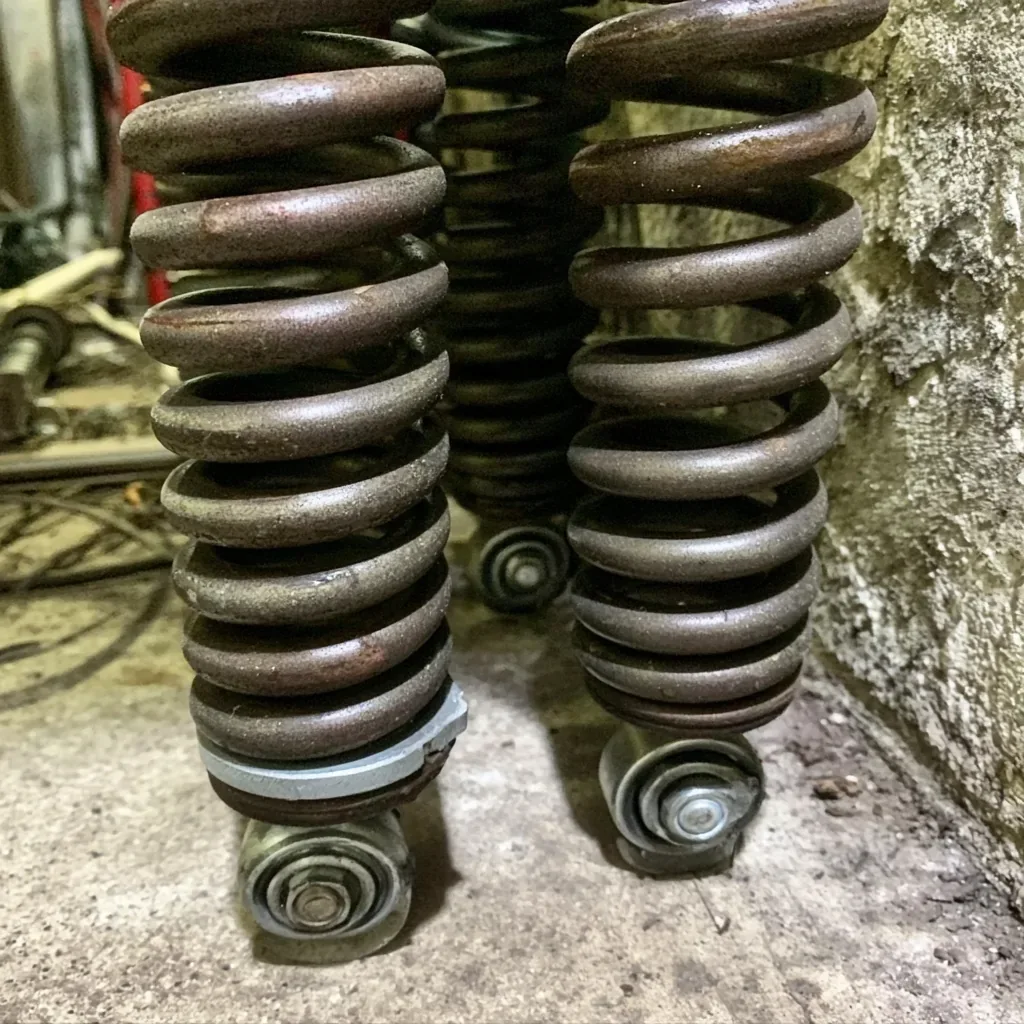
Extension springs look completely different, and they sit in a different place in many older Leawood homes. Instead of a coil over the door, look along the horizontal tracks that run back over your car toward the rear of the garage. Extension hardware uses long, stretched springs on the left and right sides, roughly parallel to those tracks. If the springs run side to side above your head rather than across the front wall, you are looking at extension hardware.
Many 1960s and 1970s ranches in north Leawood near Mission Road still carry this older layout. Each side usually has a coil several feet long, a pulley at one end, and a cable looping through. Newer setups thread a thin safety cable through the center of the coil. Many older Leawood doors lack that inner cable. You can see the pulley, cable, and long side spring from the floor. Note whether that inner cable is present without reaching toward it.
Extension Springs Run Along Tracks
The third look is a TorqueMaster system, which confuses Leawood homeowners because there is no visible coil at all. Stand back with the door closed and look above the opening for a smooth, enclosed steel tube spanning the width where a torsion shaft would be. The spring sits inside that tube. From the floor you see only painted metal, end caps, and cables running to the sides, with no exposed winding or gaps between coils.
To separate it from torsion in a Leawood garage near Ironwoods Park, remember the surface. Torsion shows open wire wrapped around a shaft with a center bracket and drums. TorqueMaster shows a clean cylinder, often seven to eight inches around, with plastic-looking ends and a winding cone hidden inside the tube. If you see a tube and cannot see individual wire loops, record it as an enclosed tube system. That one detail prevents ordering or describing the wrong parts.
TorqueMaster Hides Inside a Tube
Neighborhood age gives a useful hint across Leawood before you even look up. Central estate lots in Leawood Estates and Hallbrook, built through the 1980s and 1990s with insulated steel doors, almost always have torsion coils above 16 by 7 openings. Southern builds near 143rd Street use the same standard. If you live in a north-end ranch with a lighter non-insulated door and side-mounted hardware, extension becomes more likely. Use location as a hint, then confirm by sight.
Safe looking in any Leawood garage means the same routine. Keep the door fully closed, turn on the lights, and stand toward the middle of the bay near College Boulevard style three-car depths so you can see both sides. Look, do not pull, lift, or test tension. Note shaft versus side springs versus tube, one coil or two, and whether cables look slack. A wide photo from the floor that shows the whole opening helps the pros we connect you with understand the layout.
Clues From Door Age and Shape
Several parts get mistaken for springs in Leawood garages, especially around Town Center Plaza where carriage-house overlays hide hardware. The opener rail down the center is not a spring. The vertical and horizontal tracks are not springs. The thin lift cables at the door edges are not springs, though they connect to them. Hinges, rollers, and the rubber bottom seal also sit nearby. When you look up, follow only the coil or tube described above and ignore the opener, tracks, and cables except as landmarks.
Concrete movement can also change what you see inside a Leawood garage near Tomahawk Creek. Sharpsburg clay swells and shrinks with wet and dry seasons, and a heaved apron can rack the opening so tracks look uneven and cables hang differently. Mature oaks and maples dry one side faster. That does not change the spring type, but it explains why doors bind after a cold snap. Record the spring layout first, then note any leaning jambs or binding separately.
When You Still Cannot Tell
Knowing the name matters because Leawood subdivisions treat parts and doors differently. In most HOA areas a like-for-like spring identification needs no architectural approval, while changing the door style does. Writing down torsion on a shaft, extension along the tracks, or enclosed tube above State Line Road homes keeps the conversation exact. It also helps you confirm permit needs with the city, since a repair description is simpler than a structural change to the opening.
Once you can name what sits over your Leawood door near Roe Avenue, a few follow-up questions come naturally. How old is this particular layout, and is it original to the house. What details should photos show before anyone visits. What written scope, charges, and warranty terms should the pros we connect you with provide. The rest of this guide answers one spring question at a time so each identification step stays clear.
What to Note Before You Call
Stand in the middle of your Leawood garage and look straight up with the door closed, keeping your feet on the floor and your hands off the hardware. Note whether you see one or two tight coils on a steel shaft above the door, long stretched springs along each horizontal track, or a smooth closed tube above the opening with no exposed coil. Write down the door width and how many cars it holds, because most homes off Nall Avenue use 16 by 7 sectional steel.
Add small details that help tell the systems apart without touching anything in your Leawood garage. Look for a painted stripe on a torsion coil, round cable drums at the shaft ends, thin lift cables running to the bottom corners, or a wire safety cable threaded through any side springs. If you see a white or gray tube spanning the header with winding cones only at the ends, that points to TorqueMaster. Keep back from moving parts and work only with what you can see clearly.
Common Mix-Ups in Leawood Garages
A common mix-up in Leawood is mistaking the opener rail for spring hardware. The straight perforated bar running from the motor to the header only guides the trolley and chain or belt, while true torsion coils wrap tightly around a separate shaft mounted to the header brackets. Another mix-up is calling the horizontal track itself a spring. Along Tomahawk Creek homes and in Hallbrook, insulated steel doors hide the shaft partly behind the top panel when open, so check with the door closed for a clear view.
Side hardware causes the next confusion for Leawood owners. A thin safety cable is not a spring, it is the slender wire that should run inside an extension spring to catch it, and many 1960s ranches on the north side still show stretched side springs with that wire missing. At the other end, a TorqueMaster tube is not an empty cover or a second opener rail. It is a sealed steel tube holding the springs inside, with only end spools and cables visible, so no open coil means something different.
Photograph Details Without Touching Hardware
Good photos help you compare later without climbing or touching anything in Leawood. Stand back from the center of the floor and take one wide shot that shows the full header, shaft or tube, and top door panel together. Then zoom from the same spot for a closer view of the shaft ends, cable drums, and any side springs along the tracks. Homes near 135th Street often have high ceilings and bright windows that wash out detail, so turn off the flash and let the overhead lights even out first.
Stay off the ladder and keep hands in pockets while you look around your Leawood garage. Do not pull on cables, lift the door by hand to see better, or tap a coil to hear tension, because stored energy can move parts without warning. If boxes block the view near State Line Road garages where storage runs tight, move the boxes first and then step back. A clear floor-level look tells you the spring family, and that is enough for this step before any pro sees the door.
What Your Opener Tells You
Your opener brand does not change the spring type, but its placement can confirm what you found in Leawood. LiftMaster and Chamberlain belt and chain units hang from the ceiling center and link to the top panel, leaving the header shaft or tube fully visible above. In carriage-house overlay doors around Ironwoods Park, the decorative front hides nothing inside, so the same header check still applies. If a battery backup box hangs beside the motor for ice-storm outages, ignore it for now and keep eyes on the header and tracks.
Door size gives context without deciding the answer in Leawood. Most attached two-car sectional steel doors measure 16 by 7, with three-car fronts near Mission Road often using 18 by 7 or a double plus single split, and nearly all carry torsion coils on a header shaft. Finding long side springs instead usually means an older north-side ranch that kept its original extension hardware. Use size only to describe what you see, not to overrule a clear header photo that shows a tube or an open coil.
Questions to Ask About Your Springs
By now you can name the family, so the next questions get specific for Leawood. Is mine a single coil or a matched pair on one shaft, and does each side have its own extension spring with a safety cable? Is that header tube a TorqueMaster with hidden coils, or just a cover over a standard shaft? Photos from the floor answer most of it. Bring those wide and zoomed views when you talk with help, instead of guessing from memory about what sits above the door.
If the header view is still unclear or the door feels heavy and uneven over Sharpsburg clay near College Boulevard, stop looking and ask the pros we connect you with to confirm the type from your photos. Ask what spring family the door uses, whether both sides match, and what details they need for an exact match. Leawood doors rarely need guesswork once the shaft, side springs, or tube are clearly described from a safe distance.
Dealing with this in your home?
In Leawood, most spring trouble starts with winter, not use, as repeated freeze-thaw cycles tighten fatigued steel until a cold night snaps a coil on an attached two-car sectional door. Johnson County homes from Hallbrook to the 135th Street corridor and near Ironwoods Park often show the same pattern: a door over 150 pounds dead, an opener straining, and roots drying clay on one side of the slab. This post explains why cold breaks happen, what a safe repair visit covers, and when to call the pros we connect you with.